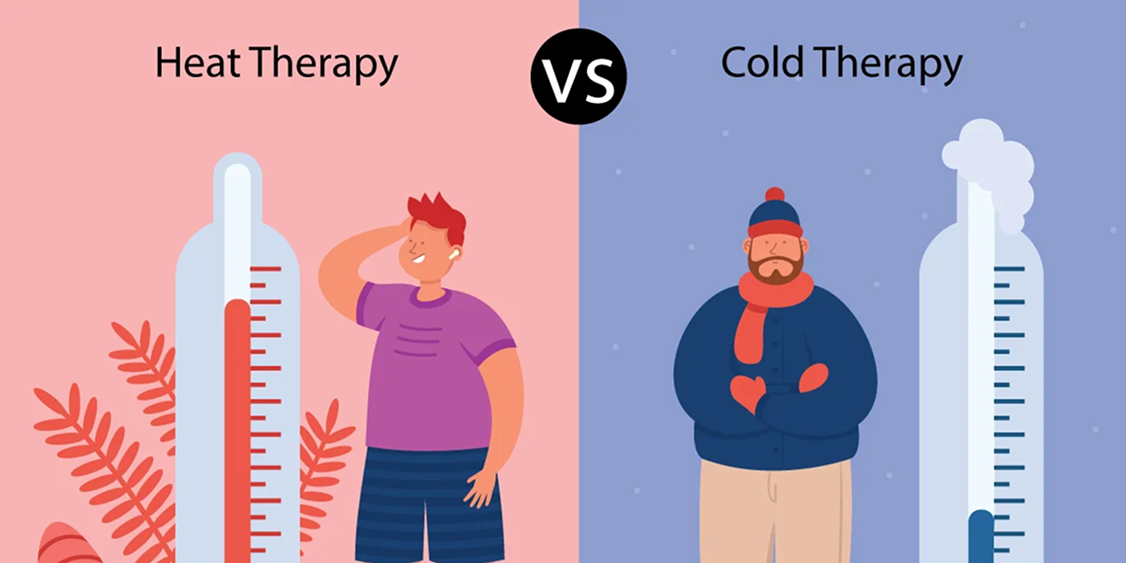
Cold vs Heat Therapy: When to Use Which for Best Results
A Complete Guide with Evidence, Science, and Practical Tips
Introduction
Whether you're an athlete, a fitness enthusiast, or someone dealing with chronic pain, you've likely wondered: “Should I apply heat or cold for my injury or pain?” Both cold (cryotherapy) and heat (thermotherapy) are widely used—but when, where, and how you apply them can make a huge difference in healing and comfort.
Cold Therapy (Cryotherapy)
Mechanism of Action
- Vasoconstriction: Cold causes narrowing of blood vessels, reducing blood flow.
- Reduces inflammation by limiting metabolic activity in tissues.
- Decreases nerve conduction velocity, which leads to reduced pain perception.
- Slows down edema formation after acute injury.
When to Use Cold Therapy
- Acute injuries (0–72 hours): sprains, strains, bruises
- Post-operative swelling
- Joint inflammation (e.g. arthritis flare-ups)
- After intense workouts to reduce delayed-onset muscle soreness (DOMS)
Research Evidence
- A study in The American Journal of Sports Medicine (Bleakley et al., 2004) supports cryotherapy’s role in reducing pain and swelling in acute soft tissue injuries.
- Costello et al., 2012 found whole-body cryotherapy reduced inflammatory markers and muscle soreness post-exercise.
Heat Therapy (Thermotherapy)
Mechanism of Action
- Vasodilation: Heat increases blood flow, helping supply oxygen and nutrients.
- Increases tissue elasticity, making muscles and fascia more pliable.
- Promotes muscle relaxation and decreases muscle spasms.
- Enhances cellular metabolism, speeding up chronic healing.
When to Use Heat
- Chronic muscle pain or tightness
- Joint stiffness (e.g. osteoarthritis, spondylosis)
- Before stretch or activity (to warm up tissues)
Research Evidence
A study by Nadler et al. (2004) in Archives of Physical Medicine and Rehabilitation showed that moist heat was more effective than cold in relieving chronic low back pain. Knight & Draper, 2012 highlight that heat therapy’s role in improving range of motion by improving connective tissue extensibility.
Contrast Bath (Hot & Cold Alternation)
Alternating immersion or compresses of hot and cold—typically used in a 3:1 or 4:1 ratio (3–4 mins hot, 1 min cold).
How it Works
- Induces pumping effect in blood vessels: vasodilation (heat) followed by vasoconstriction (cold)
- Helps flush out waste products and improve circulation
- Effective for subacute swelling, DOMS, and post-exercise recovery
Scientific Evidence
Higgins et al, 2017 (Journal of Strength & Conditioning Research): Contrast baths were more effective than cold alone in reducing post-exercise muscle soreness. Wilcock et al, 2006: Alternating water immersion improved athletic recovery, especially when compared to passive recovery.
Summary Table
| Therapy Type | Best For | When to Use | Duration |
|---|---|---|---|
| Cold | Acute injuries, inflammation, swelling | 0 to 72 hours after injury | 10 to 20 min |
| Heat | Chronic pain, tight muscles, stiffness | >72 hours post-injury or chronic pain | 15 to 30 min |
| Contrast | DOMS, sub-acute swelling, recovery | After intense training or mid-phase rehab | 15 to 20 min (Hot:Cold = 3:1 or 4:1) |
When to Avoid each Therapy
Cold Contraindications
- Cold hypersensitivity (e.g. Raynaud’s disease)
- Poor circulation or sensation
- Open wounds (unless prescribed)
- Infections
Heat Contraindications
- Active inflammation or swelling
- Bleeding or recent injury (<72 hrs)
Key Takeaway
• Cold is your friend in the early (acute) stages of injury.
• Heat is best when dealing with chronic stiffness or pain.
• Contrast baths work well for post-exercise recovery and subacute rehab.
Practical Tips
- Use ice packs or cold compresses (wrapped in a towel), either skin on skin.
- Use moist heat (hot water bottle, warm compress, steamed towel) for better tissue penetration.
- For contrast baths at home: use two buckets or alternating hot/cold compresses.
References
- 1. Bleakley, C.M., McDonough, S.M., & MacAuley, D.C. (2004). The use of ice in the treatment of acute soft-tissue injury: a systematic review of randomized controlled trials. AJSM, 32(1), 251-261.
- 2. Nadler, S.F., et al. (2004). The effectiveness of moist heat pack and cold therapy in treating chronic low back pain. Archives of Physical Medicine and Rehabilitation, 85(2), 193-200.
- 3. Costello, J.T., et al. (2012). The use of cold water immersion to reduce symptoms of exercise-induced muscle damage. European Journal of Applied Physiology, 112(7), 2443–2449.
- 4. Higgins, T.R., et al. (2017). The effect of cold, heat and contrast therapy on muscular strength and power. Journal of Strength and Conditioning Research, 31(2), 485-492.
- 5. Wilcock, I.M., Cronin, J.B., & Hing, W.A. (2006). Water immersion: does it enhance recovery from exercise? International Journal of Sports Physiology and Performance, 1(3), 195–206.